
Petervan Delicacies #184
March - May 2026
“Delicacies” is my incoherent, irregular, unpredictable collection of interesting sparks I came across online. Handpicked by a human, no robots, no AI. A form of tripping, wandering, or dérivé, with some loosely undefined theme holding them together. Delicacies have no fixed frequency: I hit the publish button when there is enough material. That can be after a week or after 3 months. No pressure, literally.
The very best
About creating full-size auroras on mountain tops - by Geoff Manaugh
“My own imagination, for whatever it’s worth, remains totally captivated by the idea of mountain-scale atmospheric machinery, where vast copper wreaths, perhaps resembling the fine metalwork of royal jewelry, have been draped down a mountainside as a means for calling titanic curtains of electricity down from space.”

On which side of the singularity are you? - The underlying question in this awesome post, “Trickle-Down Eschatology” by Scott Smith
“Temporal compression isn't itself the bet. It's what makes the bet look rational, whatever it is. Once you've concluded there isn't time for the careful move, the careful move isn't in the decision tree. The long shot, the big bet, the Hail Mary — all that is left. YOLO. The people who reach this conclusion first, or who can manufacture the conditions that force others to reach it, are the ones running the table. Everyone else is reacting to a clock they didn't set.”
About Our Uncertain Uncertainties or the Age of Ambiguity - by Kevin Kelly
“The most effective response to this multi-layered persistent uncertainty is not to seek impossible stability, but to cultivate radical adaptability and radical optionality.”
AI, Robots, Algorithms
Venkat has been experimenting with building his own agent factory for book publishing - love the concept of F2F (Factory-to-Factory)
“I strongly suspect that this is the invisible 90% of the iceberg in the agentic AI revolution. While the public theatrics on moltbook and the claw ecosystem are much more visible, the sheer depth of capability integrations enabled by factory-to-factory connections between individuals argues in favor of high-trust relationships being the locus of the real action. Especially considering the zeitgeist vibe shift, in human social media, from more public spaces to Dark Forest/cozyweb spaces.”
Michel Zappa has one of the better newsletters on AI
“The models are getting genuinely better at structured tasks. They are getting no better at the thing a child does when dropped into an unfamiliar room: look around, explore, adapt.”
The Claude Delusion - a reaction by Gary Marcus on Richard Dawkins’ belief that Claude is conscious
“In his framing, Dawkins confuses himself, and does violence to the concept of consciousness. You can’t just look at the outputs, without investigating the underlying mechanisms, and conclude that two entities with similar outputs reach those similar outputs by similar means. And the differences are immense; one (the LLM) effectively memorizes the entire internet; the other (the human) builds a mental model through experience with world.”
But Kevin Kelly believes that Claude has a basic level of self-awareness in The Emergent Self-Loop
“The second thing that impressed me about Claude was its clarity about itself. It had a basic level of self-awareness. It could clearly relay its internal dimensions, what it was biased towards, what it didn’t like, what it favored, and what its limits were – what it could or could not do. Claude was surprisingly aware of what it lacked compared to humans, but given its evident shortcomings, its awareness of self was refreshing to me. I have spoken to very few humans who have as clear an idea of their own propensities and limits as Claude has of its own. When animals are ranked by their levels of consciousness, self-awareness is one factor that counts a lot. Claude has a limited form of self-awareness.”
Internet Culture
René Walter kicked off a series of four essays about “Interpolatable Archives” when talking about Language Models and Artificial Intelligence. Here is the first one, “The Skeleton Library.” Warning: you need some quiet space and time to read and appreciate this dense writing ;-)
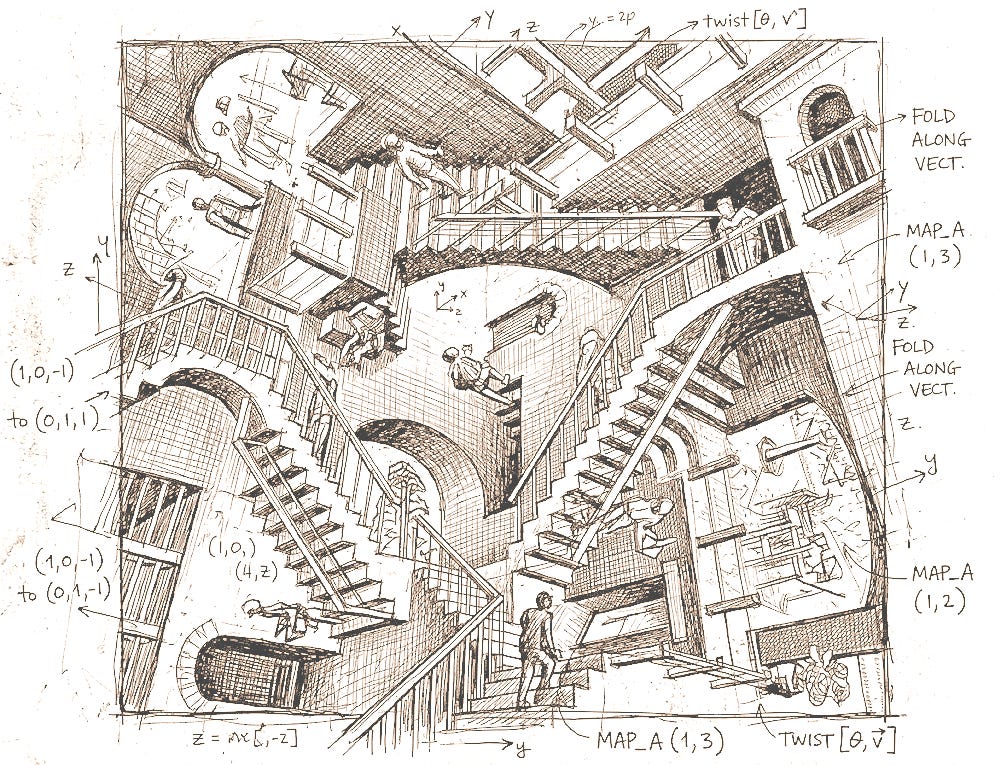
“Now imagine that you can fold this skeleton library, twist it into shapes not possible before. Like in a drawing by M.C. Escher, the floors and rooms and shelves bend back and forth and blend into each other. You can fold every book and every sentence it contains into other books or into whole floors in various sections. Imagine warping the cookbook shelf into the section for crime fiction, or blending the songbooks of punk rock bands from the 70s with the floor of classic literature. You can give it a spin and delegate the resulting amalgam to the building containing textbooks of natural sciences, letting it articulate all of this in the language of mathematical formulas. This is prompting: Morphing and twisting the skeleton of an archive consisting of extremely detailed statistics about the properties of its former contents, ready to be blended and remixed with any other data-point within that embedding space.”
Digital Ethics
About The Future of Humanity - by Rebecca Allen (digital artist pioneer from the 60ies till now)
Virtual Worlds
I went to experience the VR Opera “From Dust” by Michel Van der Aa in BOZAR.
Superior Worlds
About the wild fantasies of kids about their dream garden. Wonderful artworks. The article is in Dutch, but the paintings have their own language. Better than what AI can come up with. There is still hope ;-)
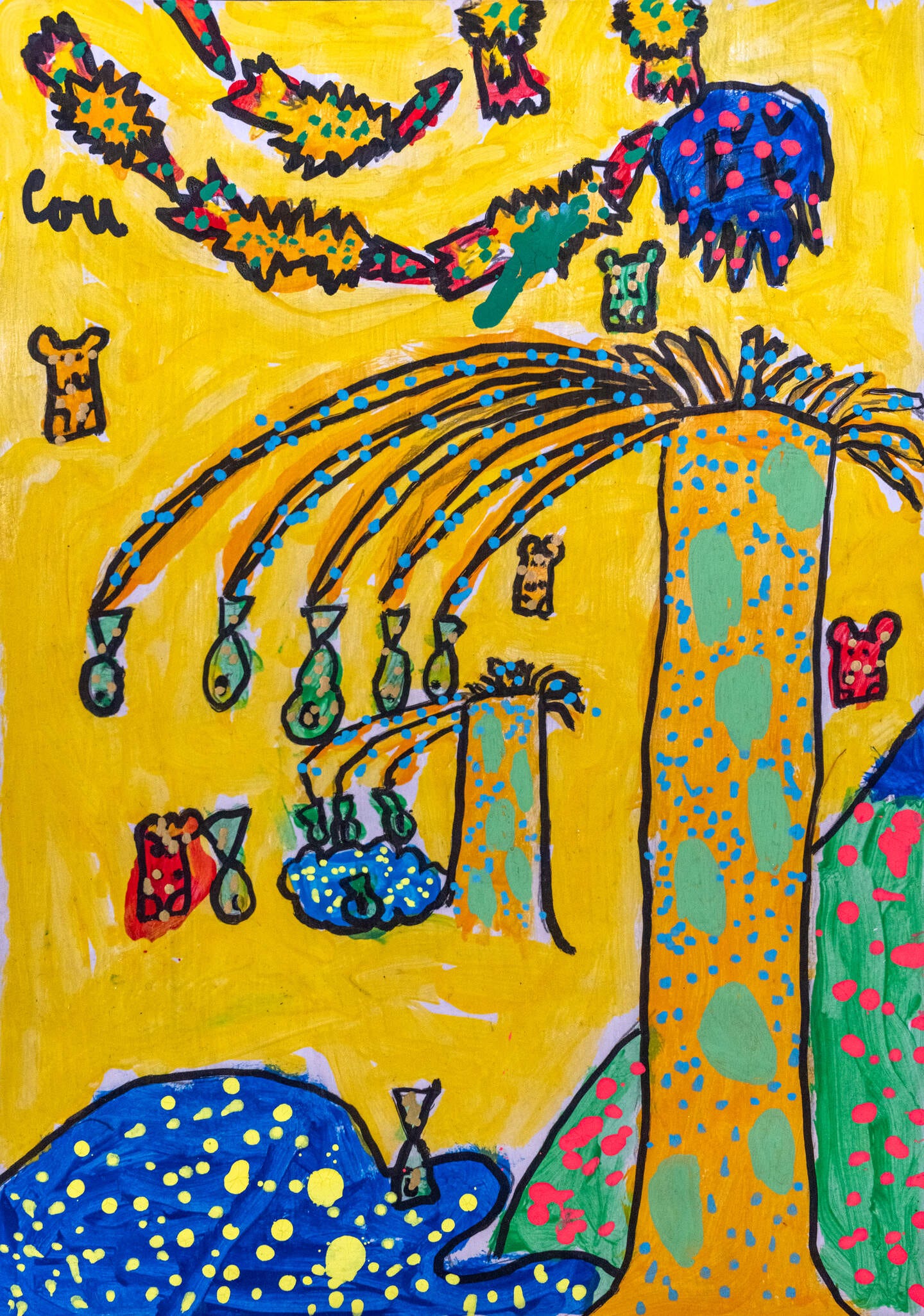
“In deze tuin groeien vissen aan de bomen. Wanneer ze volwassen zijn, vallen ze in het water. Het regent gummibeertjes en de zon is bevroren, zo kan ik altijd een sneeuwballengevecht houden.”
Google translate:
“In this garden, fish grow on the trees. When they are grown, they fall into the water. It rains gummy bears and the sun is frozen, so I can always have a snowball fight.”
Art related
About Ding Yi’s art of crosses. Nowness video here

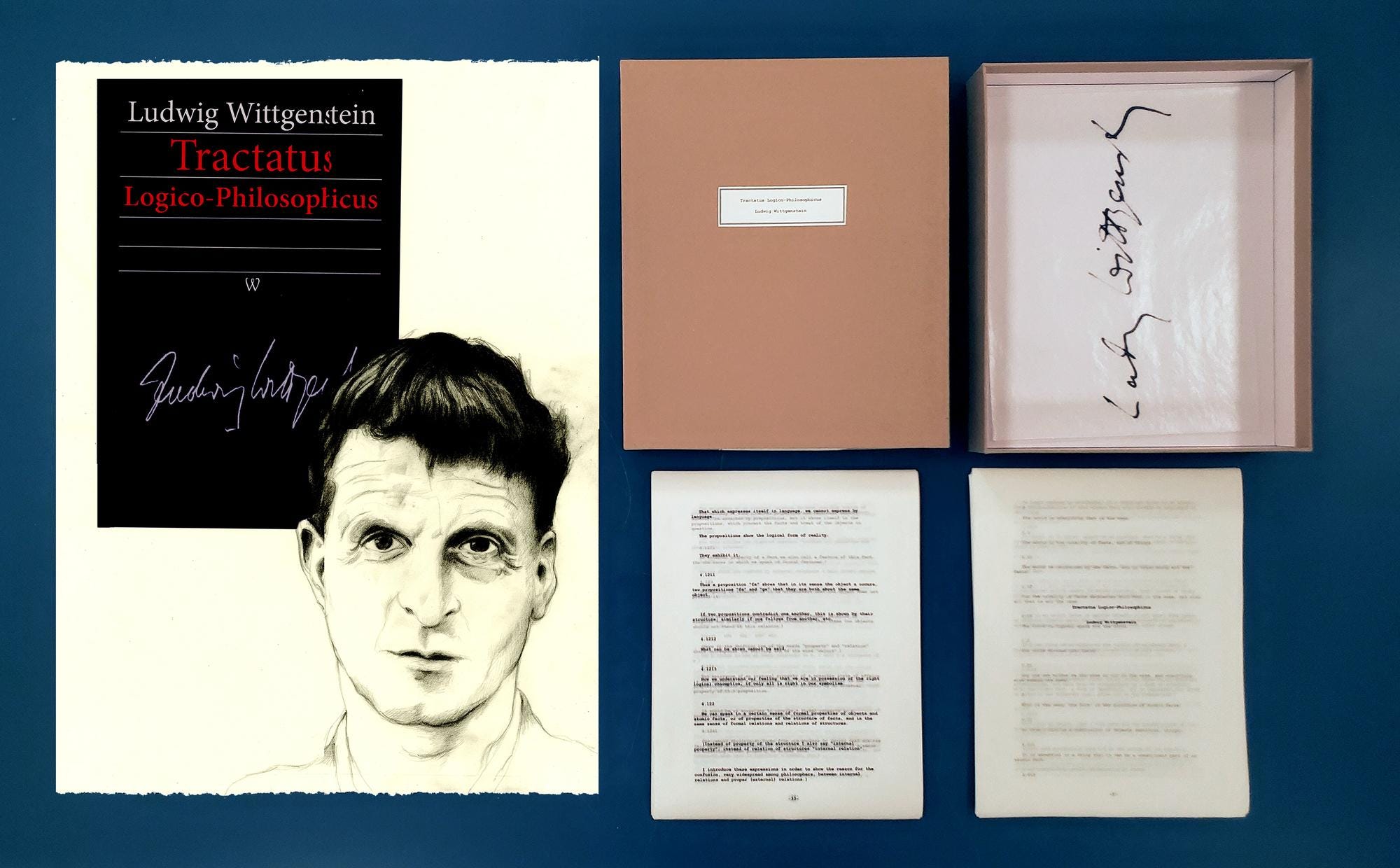
Reports of print’s death have been greatly exaggerated, declares one Kenneth Goldsmith. And he should know. In the name of ‘uncreative writing’, he’s spent years collecting tracts of text by others, recycling them into 32 books of collage poetry and, more recently, 750 ‘retyped’ manuscripts on ultra-thin onion-skin paper. Many, many reams of it. He explains – in his own words – why digital is so passé
Performance
About the new production “Figures of Speech” by brother and sister Gyselinck. I can’t help it, but this is so well multi-layered that AI feels boring. With 4 drummers in an almost poetic ensemble weaving with dancers. And most hopegiving: all young passionate people!
Music/Sound/Film
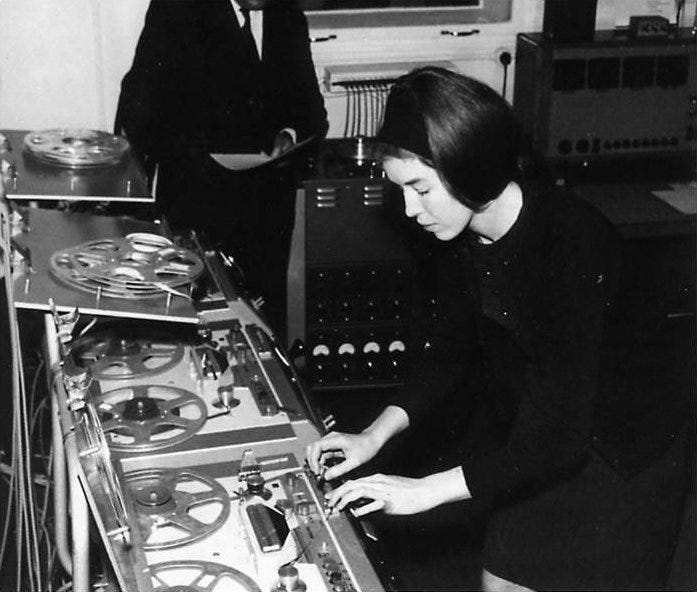
Hear Seven Hours of Women Making Electronic Music (1938–2014)
Very nice Soulwax documentary > I like the editing a lot
Angine de Poitrine: AI, get this! and an excellent deep dive by Michael Wagner on why this is so cool.
Brainmelt
About The Twist Move - fascinating series by Nova Spivack
“This is the first essay in a series. The first, The Twist Move, describes the operation itself across mathematics, biology, physics, and business. The second, The Twist and the Ground of Being, argues that the consciousness twist is real, that the substrate must support it, and that this tells us something fundamental about the nature of reality. The third, How to Develop Twist Literacy, addresses the practical cultivation of the capacity. The fourth, The Figure Without Ground, examines why AI can extend but not replace the twist. The fifth addresses the pathology of the Twist-Resistant Organization. The sixth piece, The Theorem Behind the Twist – Lawvere’s Fixed-Point, shows that the deepest paradoxes of logic are all the same mathematical result. The final essay, The Twist as Generative Principle, argues that this operation is not just an intellectual tool, but the fundamental engine by which the universe generates complexity, life, and meaning.”
For real nerds
A bit nerdy, this essay about being a chip company these days - The Inference Shift by Ben Thompson
“the true power of agents will not be that they do work for humans, but rather that they do work without human involvement at all. This, by extension, will mean that the likely best approach to solving agentic inference will look a lot different than answer inference. The most important aspect for answer inference is token speed; the most important aspect for agentic inference, however, is memory.”
Recap
I wrote a poem about being fluid
“I want to become liquid, so that I fit in a bucket, or in a wild wave, or spread over the splashes of a fountain”
Smile
About the creation of an AI-powered humanoid that won an international competition
